AI Without Context Is Useless
How OpenAI, Anthropic, and Google are racing to solve the context problem
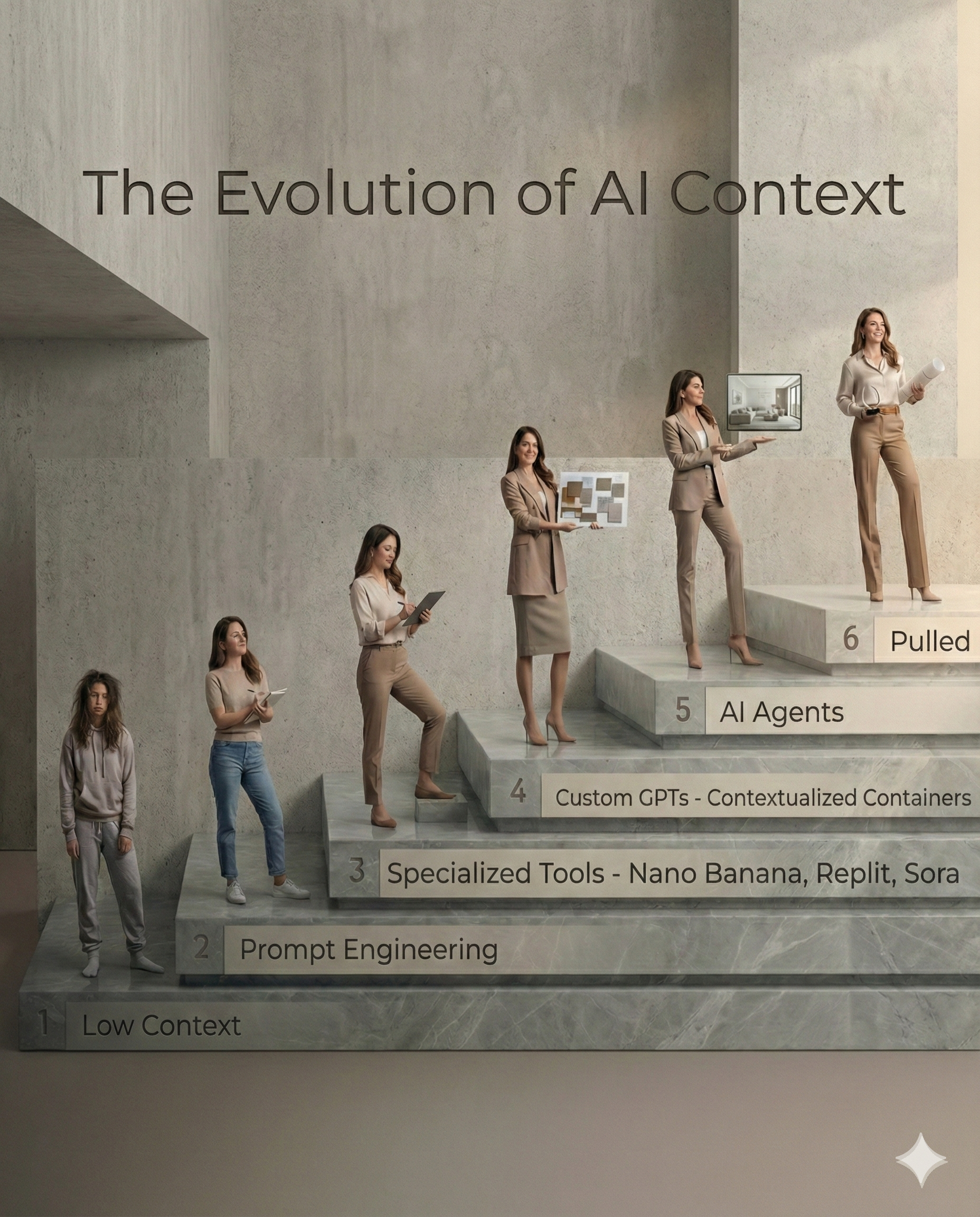
AI without context is completely useless. ChatGPT, Claude, and Gemini have incredible intelligence, but without context about your specific situation, they match generic patterns and deliver generic answers. Every AI advancement since 2022 has focused on solving this context problem through six distinct phases: low-context search, prompt engineering, specialized tools, contextual containers like custom GPTs, AI agents, and socratic questioning systems that actively pull context from users.
Imagine hiring the world's most intelligent marketing manager. Unparalleled genius who knows everything about marketing, branding, social media, and client psychology. On their first day, you tell them "update our marketing campaign." What happens? They produce generic garbage.
Not because they lack intelligence. Because genius without context is useless.
AI works exactly the same way. OpenAI, Anthropic, and Google all understand this fundamental problem. That's why every major AI advancement focuses on improving context delivery.
Apple - Youtube Music - Spotify - Youtube
-
The Core Thesis: Genius Without Context is Useless
Imagine hiring the world's most intelligent person as your new marketing manager—an unparalleled genius who knows everything about branding, social media, and client psychology. If you tell them to update a campaign on their first day without any background information, they will produce generic garbage.
Genius without context is useless. As we head into 2026, AI is that genius, but the quality of its work depends almost entirely on the context we provide.
How AI "Thinks"
To use AI effectively, we must understand that it doesn't think like a human. It matches patterns. Specifically, it tries to find and match patterns that it thinks will please the human user. It isn't looking for "truth"; it’s looking to satisfy the prompt.
Without context: AI matches generic patterns and gives generic answers.
With context: AI matches nuanced, specific patterns to give better, more useful results.
The 6 Phases of AI Evolution
The history of AI can be viewed as an incremental improvement in how context is handled:
Phase 1: Low Context (The "Google" Era) When ChatGPT first launched, we used it like a search engine with short questions. It was impressive at first, but after six months, users became underwhelmed by the surface-level, basic responses.
Phase 2: Prompt Engineering We were told that to get better answers, we had to ask better questions. For a time, "Prompt Engineer" was touted as the career of the future.
Phase 3: Specialized Tools Tools like DALL-E, Nano Banana, or Sora emerged. These have the context pre-loaded into the tool itself, so users don’t have to engineer complex prompts to get specific results.
Phase 4: Contextual Containers This brought us Custom GPTs, Claude Projects, and Gemini Gems. These allow users to upload specific documents and instructions that the AI refers to every time, solving the problem of the AI "forgetting" details.
Phase 5: AI Agents The difference here is action. An agent takes the context you’ve given it and actually goes out to execute tasks on your behalf.
Phase 6: Holding/Pulling Context This is the future: Socratic AI. Instead of just answering your question, the AI asks you questions to extract more context. It is resource-intensive and complicated to build, but it closes the gap between super-intelligence and your specific needs.
What This Means For You
The next time an AI gives you a frustrating answer, realize that the problem isn't a lack of intelligence—it's a lack of context. You have a few choices on how to handle this:
Get better at prompting: It’s free, but takes effort.
Use Contextual Containers: Pay for Claude Projects or Custom GPTs to store your data.
Use Socratic Tools: Seek out specialized tools that interview you to get the best results.
Wait: Eventually, companies like OpenAI and Anthropic will build more context-handling directly into their models.
Final Thought
You don't need to be a prompt engineer or take an AI course. You simply need to evaluate every interaction through the lens of context. If the AI fails, ask yourself: "What does it not know about my specific situation?"
Next Video Preview: I’ll be diving into AI Sycophancy (or "AI Glazing")—the tendency for AI to agree with everything you say—and reviewing Anthropic's recent take on the subject.
Key Takeaways:
AI without context is useless - Without specific context about your situation, even the most intelligent AI matches generic patterns and produces generic answers. This is the fundamental problem every AI company is racing to solve.
Six phases define context evolution - The AI industry has progressed through low-context search (ChatGPT launch), prompt engineering, specialized pre-loaded tools, contextual containers (Custom GPTs/Claude Projects), AI agents, and emerging socratic questioning systems.
Every AI advancement centers on context - OpenAI, Anthropic, and Google have focused every major innovation since 2022 on closing the gap between AI intelligence and user needs through better context capture, storage, and utilization.
Custom GPTs solved the forgetting problem - Phase 4 contextual containers let you load context once and have AI reference it forever, eliminating the need to re-explain your situation in every conversation.
AI agents combine context with action - Phase 5 AI agents don't just store and reference context—they use contextual understanding to take action and execute tasks based on your specific needs.
Socratic AI represents the future - Phase 6 hold context systems actively pull context from users through intelligent questioning rather than waiting for users to provide it, though this requires significant processing resources most AI companies haven't implemented yet.
Why AI Companies Prioritize Context Above Everything
OpenAI, Anthropic, and Google have made dozens of AI improvements since ChatGPT launched in 2022. New models, faster processing, multimodal capabilities, longer context windows. But look closely at every major advancement and you'll see one common thread: they're all solving the context problem.
Custom GPTs let you store context. Claude Projects remember your preferences. Specialized tools come pre-loaded with domain context. AI agents use context to take action. Emerging socratic AI systems pull context from you through intelligent questioning. Every innovation addresses the same fundamental issue: genius without context is useless.
Your Framework for Evaluating AI Tools
Understanding the six-phase context evolution changes how you evaluate every AI tool. When you try a new AI platform, ask yourself: How does this tool handle context? Does it make me re-explain everything in each conversation (Phase 1)? Does it require complex prompting (Phase 2)? Does it have specialized context pre-loaded (Phase 3)? Can I store my context permanently (Phase 4)? Can it take action based on context (Phase 5)? Does it actively pull more context from me (Phase 6)?
Tools that handle context better deliver better results. It's that simple. The six-phase framework gives you a lens for understanding why some AI interactions work brilliantly and others fail completely.
The Transformation Available Right Now
You don't need to wait for AI companies to build better context systems. You can improve your AI results today by choosing tools that match your context needs. Custom GPTs and Claude Projects cost money but eliminate the need to re-explain your situation constantly. Specialized tools come with domain context already built in. Understanding which phase a tool operates in helps you set realistic expectations and choose the right tool for your specific work.
When AI fails to help you, it's almost always a context problem. AI companies know this. They're racing to solve it. And now that you understand the six-phase evolution, you're ahead of almost everyone using AI in 2025.
Join the Interior DesignHer Community
If you enjoyed this guide and podcast, you're going to love all the other business education resources we're bringing to interior designers.
As interior designers ourselves, we created Interior DesignHer to bring top-notch business education to interior designers. We especially have a soft-spot for interior design solopreneurs & micro-businesses.
Subscribe now so you never miss our latest business guidance, guest interviews, and insider strategies specifically for interior designers.